01 Automotive Proving Grounds and Test Tracks

The controlled environments where chassis dynamics, powertrain limits, and structural integrity are quantified before a vehicle reaches public infrastructure.

02 The Core Testing Environments

Modern vehicle development relies heavily on specialized closed-course infrastructure. A proving ground consolidates diverse topographies, friction coefficients, and climatic conditions into a single secure perimeter. This allows engineering teams to execute repeatable tests, from steady-state cornering to accelerated lifecycle testing, free from the variables of public traffic.

Read Our Editorial Standards
Area 1

Vehicle Dynamics Area (VDA)

Expansive, flat asphalt surfaces devoid of obstacles, utilized for analyzing limit-handling maneuvers, electronic stability control calibration, and tire grip threshold testing. Often equipped with sophisticated irrigation systems to manipulate the coefficient of friction.

Explore VDA Specifications →
Area 2

Climatic Testing Chambers

Enclosed facilities capable of simulating extreme atmospheric variables. These chambers assess cold-start capability, HVAC efficiency, and component thermal degradation across vast temperature spectrums.

Explore Climatic Testing →
Area 3

High-Speed Circuits

Continuous circuits, often featuring banked parabolics, constructed to evaluate aerodynamic stability, thermal management under sustained load, and maximum velocity potential.

Explore High-Speed Circuits →
Area 4

NVH & Durability Tracks

Precisely engineered irregularities, including Belgian pavé and washboard surfaces, designed to accelerate chassis fatigue and isolate acoustic intrusions into the cabin.

Explore NVH Surfaces →
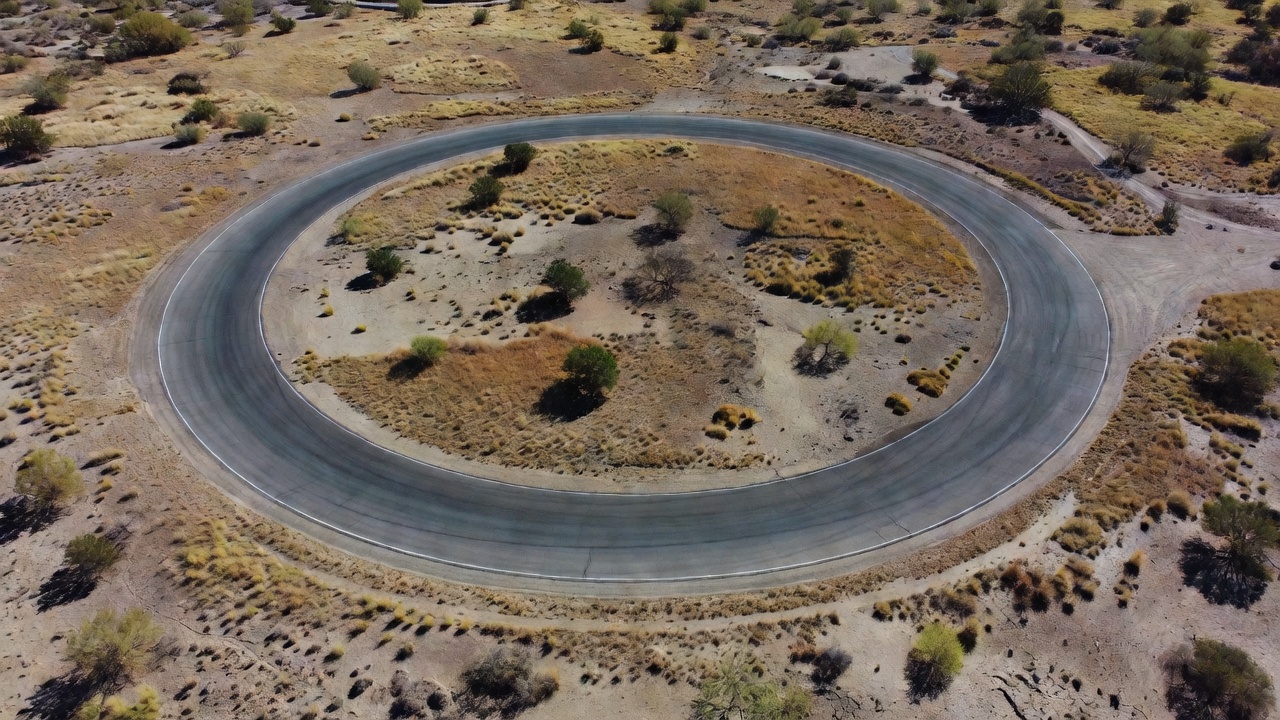
Aerial view of a curved asphalt test track surrounded by sparse vegetation

Parabolic banking allows for neutral steer at high velocities, minimizing lateral tire scrub during endurance runs.

03 Instrumentation and Data Acquisition

Physical tracks are only half the equation. Modern proving grounds integrate extensive telemetry networks. Vehicles are fitted with wheel force transducers, optical slip angle sensors, and precision GPS units accurate to the millimeter. This hardware relays high-frequency data to control centers, allowing engineers to correlate subjective driver feedback with objective mathematical models.